


From this desolate mountaintop battlefield, the divide between Virginia and West Virginia comes clearly into view.
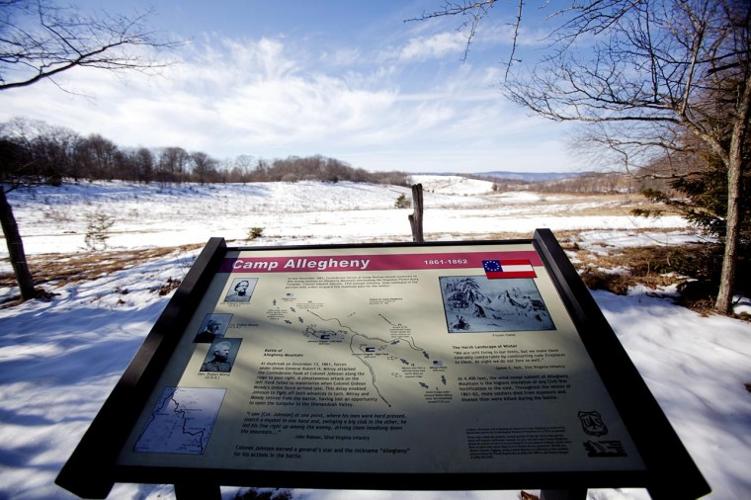
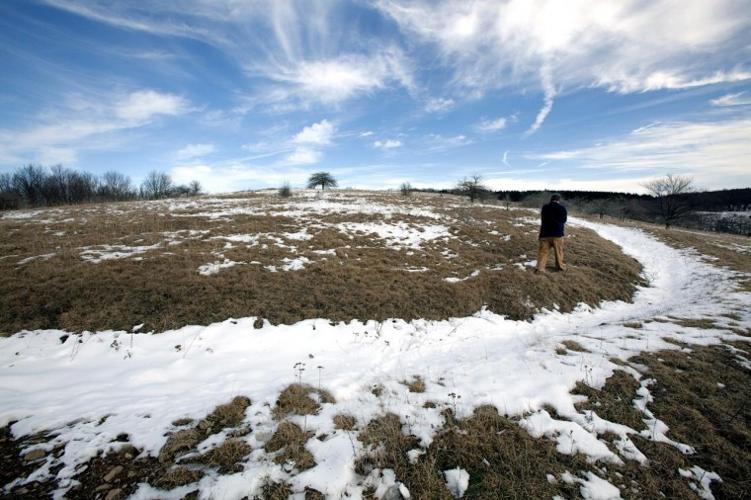
Here on the snow-covered balds, where leveled pits and piles of chimney stone remain from Civil War cabins at Camp Allegheny, Confederates won a small but critical battle at the end of the first year of the Civil War.
That action on Dec. 13, 1861, stopped the Union march across counties that would become West Virginia. Victory meant that Highland County, just to the east, would remain in Virginia. Pocahontas County would become part of a new state.
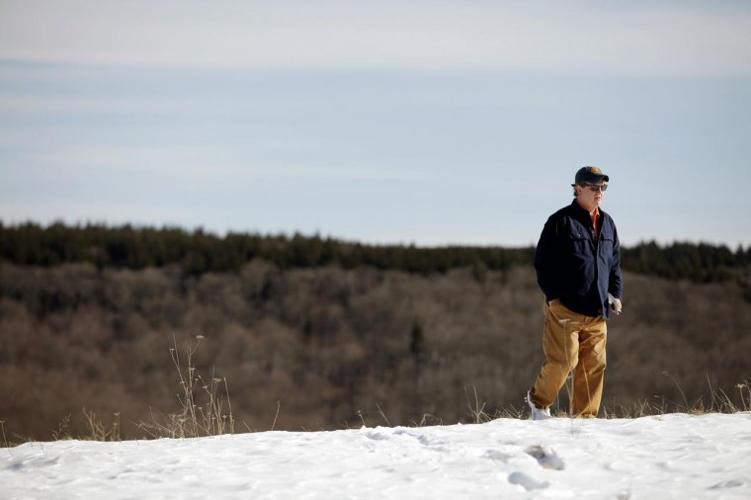
"Once they stopped them here, that's where the state line went," said John D. Hutchinson, who's worked on historic preservation and land-use projects in the Shenandoah Valley as principal in the Jennings Gap Partnership. "It's tangible evidence of how the war still affects the things we do today."
People are also reading…
The western Virginia battles in 1861 were small by later standards, but they had a huge political impact. The military backing gave time to politicians who wanted to break away from Virginia.
"What's going to secure the statehood movement?" asked Mark Snell, history professor at Shepherd University in Shepherdstown, W.Va., and author of "West Virginia and the Civil War."
"It's going to basically be the military protection behind the fledgling government in Wheeling, allowing it to ponder the creation of the 35th state," he said.
The Civil War became a vehicle for addressing issues within the state as well as within the nation.
"The issues that divided North and South in 1861 were in many ways the same issues that divided eastern and western Virginia," said Hunter Lesser of Elkins, W.Va., author of "Rebels at the Gate: Lee and McClellan on the Front Line of a Nation Divided."
"It is fitting that the first campaign in the American Civil War would take place in western Virginia," he said.
* * * * *
Slavery had less support in the mountainous regions of Virginia, where less than 4 percent of Virginia's total slave population lived, Lesser said. "There was less need for them" on the small, hardscrabble subsistence farms and in the budding industries of coal, iron, glass and salt making.
Geography also played a role in the split. "There had always been tension between east of the mountains and west of mountains," Snell said. In Wheeling and Morgantown, for instance, people were much closer to Ohio and Pennsylvania than to Richmond.
"They had a much different outlook about what they should be getting from the Richmond government," Snell said. "When the Civil War begins, people in the northwest say, 'Virginia is seceding. We don't want to secede. We don't like the rest of the commonwealth. We want to create a restored government and ask Lincoln to recognize us.' "
A loyal Virginia government was needed to legally create a new state under the U.S. Constitution, because the Virginia legislature had to approve any new state formed within its boundaries.
"I can't predict it, but I can't imagine the Richmond government allowing a resource-rich part of the state to just go," Snell said. "These early campaigns are protecting this fledgling government in Wheeling, allowing it to go through the process."
Even though the division was ultimately successful, it wasn't universally appreciated in the western counties.
"What's surprising is that West Virginia was the most divided state in the Union, more than Maryland or Missouri or Kentucky," Snell said. "We know this by looking at enlistments." About 20,000 Confederate and 20,000 Union recruits came from the counties of West Virginia.
"That's right down the middle. It's bitterly divided, lots of guerilla warfare, as bad as Missouri. It's kind of a thorn in the side of the Lincoln administration. It has to be treated as a conquered area even though it's a Union state. A good portion of the state was strongly Confederate."
* * * * *
Soldiers remembered the first winter in West Virginia as brutal.
"It is snowing; the wind is blowing a hurricane; it is as cold as the North Pole; and of all the dreary and desolate places on earth, this is entitled to be the palm," wrote a soldier from Camp Alleghany, whose letter appeared in the Richmond Daily Dispatch on Nov. 30, 1861. "Yet, the boys are in spirits, their loud halloo, jocund laughter, and occasionally the enlivening sound of the fiddle ... break on my ears above the flapping of tents and the whistling of the tempest. . . .
"A bleak and disagreeable winter will we have here, after a hard and unfortunate campaign. ... I will, if the ink does not all freeze up, some day give you an intelligible description of this waste place in nature, the Alleghany region, and the horrors of its winter storms, and the ills of life amidst them."
Sam Watkins, a Tennessean describing his forced marches through western Virginia, said in an 1881 memoir that he endured "the coldest winter known to the oldest inhabitant of these regions."
"Situated in the most mountainous country in Virginia, and away up near the Maryland and Pennsylvania line, the storm king seemed to rule in all his majesty and power," Watkins wrote.
"Snow and rain and sleet and tempest seemed to ride and laugh and shriek and howl and moan and groan in all their fury and wrath. (On a January march to Romney), icicles hung from (soldiers') clothing, guns and knapsacks. Many were badly frost bitten, and I heard of many freezing to death along the roadside."
John S. Robson, a private in the "foot cavalry" of the 52nd Virginia Infantry, recalled in his 1898 reminiscence, "How a One-Legged Rebel Lives," that half a dozen members of his company died after the battle of Allegheny Mountain.
"In fact, nearly all the wounded died from cold and exposure to the inclement winter weather, and we all suffered severely," Robson wrote. "We made our winter quarters as comfortable as we knew how, but we were green campaigners, and the best we knew was awkward enough. We had got some tents, and these, with log huts and plenty of fire, kept us in some sort of comfort, but during this bleak winter the boys talked a good deal about their 'twelve months' term of enlistment expiring in the spring, and not quite so much of their fear that the war would be too short to give to them a taste."
The bitter cold continued into April, after Confederate and Union armies had moved their campaign into the Shenandoah Valley. Henry H. Dedrick, in an April 7, 1862, letter to his wife from Augusta County, was still complaining that "It is very cold and snowy. We all just have to do the best we can. We are nearly froze. All the balance of my mess is lying down in the tent wrapped up in there blankets. I wish you could see us, then you would say that we had hard times out here."
* * * * *
Military implications of the first campaign weren't as obvious as a new state line, but they were also significant.
Two generals who led parts of the West Virginia campaign — George B. McClellan for the Union and Robert E. Lee for the Confederacy — would become the top commanders for the North and South, at least partly because of what happened in West Virginia.
McClellan, a West Point graduate who was working for the railroad at the start of the war, assembled his first army of almost 19,000 men at the request of the Ohio governor.
"It was rather impressive," Lesser said. "While he was building it, organizing this army, he was receiving pleas and visitors from western Virginia urging him to rescue them from the Confederates."
The B&O Railroad line was the first objective for both sides. Outnumbered Confederates had to withdraw from the railroad hub in the Federal-leaning town of Grafton about 30 miles from the Pennsylvania line, and then they were routed in the first land battle at Philippi, about 15 miles south.
Fighting then moved along the Staunton-to-Parkersburg Turnpike, which had been built by Virginia about 20 years earlier to open up the wilderness.
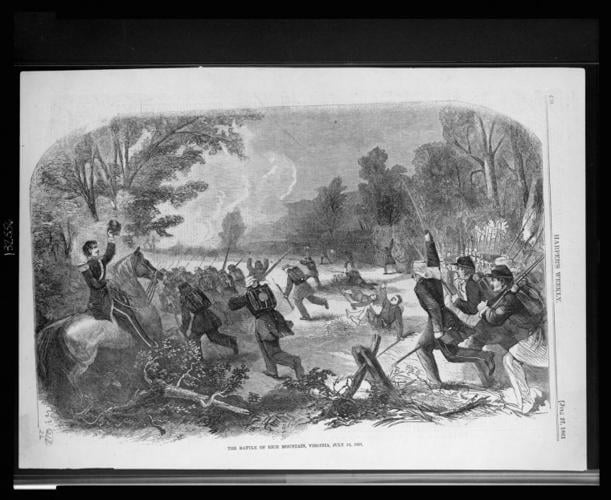
At Rich Mountain, McClellan seized the credit for Union victory even though Gen. William S. Rosecrans planned and fought the battle.
McClellan failed to carry out a planned frontal attack to support Rosecrans' attack from the rear. He didn't even know the results of the battle for 12 hours, Lesser said. But he was quick to use the new telegraph lines that followed the Union army.
"Think of it as 19th century Twitter: 'I have the honor to inform you that the army under my command has gained a decisive victory. We have annihilated the enemy in Western Virginia. ... Our success is complete & secession is killed in this country,' " Lesser said. "A bit exaggerated, but it played well. Northern newspapers picked up McClellan's words and in many cases transferred them verbatim in headlines. Overnight McClellan became the North's first battlefield hero."
Less than two weeks after the July 13 Union victory at Corrick's Ford, in which Confederate Gen. Robert S. Garnett was killed, the Union had a "shocking setback" at Manassas, the first big battle of the war.
"The North needed a new leader," Lesser said. "Who was the only Union officer who had any victories under his belt? George B. McClellan. So he got the call via telegraph."
Lee, meanwhile, went west in August to coordinate a campaign to regain the lost ground. Weather conspired against him. Rain turned the road into a 90-mile sea of mud. Nights got so cold that water froze in buckets in August.
"The cold is greater than I could have conceived," Lee wrote to his family. "Even in my overcoat with all my clothing on, I am still cold."
One soldier claimed that it rained 32 days in August, Lee said.
On Aug. 13, it snowed.
* * * * *
By Sept. 11, despite another storm, Lee had organized an attack on the Union fortress at Cheat Mountain. The cold, foggy morning created an acoustic shadow, muffling the signal to attack, and the assault degenerated into a unsuccessful series of skirmishes.
Another retreat took the Confederates to Camp Bartow, where the Battle of Greenbrier River on Oct. 3 was inconclusive. Confederates retreated again to a stronger position at Camp Allegheny, where they could see the Union campfires on Cheat Mountain.
On Halloween, Lee separated from his troops and returned to Richmond, in effect leaving western Virginia to the enemy, Lesser said. To add to the insults, before Lee left, the citizens of western Virginia had voted Oct. 24 to create a new state.
"Lee was written up in Southern newspapers severely. They wrote he was out-generaled. They gave him nicknames like Granny Lee," Lesser said. "Lee's failure was complete.
"The only tangible legacy from the campaign was that Lee grew a new beard which he kept for the rest of his career, the rest of his life. And, while in Greenbrier County, he first saw a magnificent horse which would become the warhorse Traveller."
Lee learned from his failure and became a better general. McClellan did not.
"McClellan had fatal flaws that were evident in western Virginia but were overlooked," Lesser said. His reluctance to move and exaggeration of enemy numbers would plague his Peninsula campaign against Richmond the following year.
"The rapid rise to high command for McClellan was a direct result of the first campaign. It would prolong the war," Lesser said. "It took Lincoln and the north almost a year to realize that McClellan was not the general they thought he was, until he was finally dismissed by Lincoln for what the president called a hopeless case of the slows.
"But under his watch, the war that began to save the Union evolved into a war to end slavery. That's a powerful legacy, and it's part of the legacy of the first campaign."


