


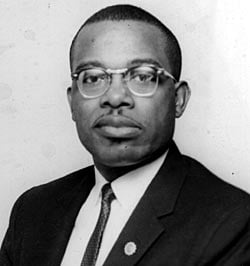
The Rev. Curtis W. Harris began fighting for civil rights during the 1950s, and he has yet to stop.
During the 1950s and ’60s, Harris worked as a janitor at what was then Allied Chemical Corp. in Hopewell. In the early ’50s, he became a union shop steward and pushed the company to hire African-Americans for positions beyond that of janitor.
“We thought that black people ought to have the opportunity to go into higher positions,” Harris says.
It wasn’t long before Harris was leading protests against the whites-only policy at the Hopewell public pool. The city closed the pool, he says.
Harris, who was ordained as a Baptist minister in 1959, deepened his participation in the civil-rights movement. He organized protests and sit-ins around Virginia. He was arrested more than a dozen times across the country.
People are also reading…
A native of Surry County, Harris was a child when he moved to Hopewell with his mother and five siblings. He graduated from Hopewell’s public schools. The city remains his home.
“My mother was a mild-mannered lady, but she didn’t take no stuff,” Harris says. “I think I must have taken after her.”
Harris began his civil-rights leadership role as president of Hopewell’s chapter of the National Association for the Advancement of Colored People. In 1960, he founded the Hopewell Improvement Association, which became a chapter of the Rev. Dr. Martin Luther King Jr.’s Southern Christian Leadership Conference.
Harris marched with King in Alabama and served on the national board of the SCLC.
“When the sit-in movement started, Dr. King became my mentor,” Harris recalls. “He was mild-mannered, but he had a charisma that was out of this world.”
A few years after King was assassinated, Harris switched his focus from fighting the establishment to attempting to join it in order to change it from within. During the 1970s, he made two unsuccessful bids for the 4th District seat in the House of Representatives.
“We always considered trying to get people inside, to see if we could perfect something,” he says.
Harris also mounted seven campaigns for a seat on the Hopewell City Council. He finally won in 1986, after filing a discrimination lawsuit against the city that resulted in redrawn voting districts.
While on the City Council, Harris continued taking stands against discrimination. During the 1980s, Harris and the Virginia SCLC chapter marched on Fort Lee and the city of Colonial Heights and filed bias complaints against some Richmond-area employers.
Harris had a mild stroke in 1992, but it barely slowed him. He became Hopewell’s first black mayor in 1998 and is still a city councilman. He is still pastor of Union Baptist Church, a position he has held since 1961. Retirement remains in the future for Harris, who is 81.
“No one really knows that they’re making history. They do what they think needs to be done,” Harris says. “There are a lot of things left to be done.”


