


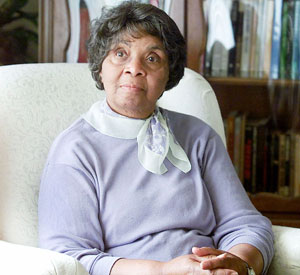
Before there was Rosa Parks, there was Irene Morgan.
She's not as well known as Rosa Parks, whose name is synonymous with the start of the civil rights movement, but their stories are remarkably similar.
Both African-American women refused to follow the segregation laws that required them to give their bus seats to white people. Both were arrested. And, eventually, both were supported by the Supreme Court, which heard their cases and struck down those laws. The rulings were turning points in the battle for civil rights.
The difference is that Irene Morgan's act of courage occurred in Virginia in 1944, 11 years before Rosa Parks' arrest, which sparked a 381-day bus boycott in Montgomery, Ala.
"If something happens to you which is wrong, the best thing to do is have it corrected in the best way you can," said Morgan, who turned 84 in 2001. "The best thing for me to do was to go to the Supreme Court."
People are also reading…
In July 1944, Morgan was a 27-year-old mother of two, living in Gloucester County. She had been ill, and one Sunday morning she boarded a Greyhound bus for Baltimore, where she was to see a doctor.
She sat down four rows from the back of the bus, in the section for "colored" people. When a white couple needed seats, the driver told Morgan and her seatmate to move farther back.
Morgan said no.
The bus driver stopped in Middlesex County and summoned the sheriff, who tried to arrest Morgan. She tore up the arrest warrant, kicked the sheriff and fought with the deputy who tried to drag her off the bus.
He succeeded, however, and Morgan was jailed for resisting arrest and violating Virginia's segregation law.
When she went to court, Morgan pleaded guilty to the first charge and paid a $100 fine. She pleaded not guilty to the second charge, but was found guilty and fined $10.
Morgan could have quietly paid the fine, but she appealed her case, and her lawyers took it all the way to the Supreme Court. In 1946, the justices ruled 6-1 that Virginia's law enforcing segregation on interstate buses was illegal.
"When something's wrong, it's wrong. It needs to be corrected," said Morgan, whose married name is Kirkaldy.
But the ruling didn't have an immediate effect. Just a few months after the court's decision, a group of 15 men, blacks and whites, decided to test it. In 1947, they traveled throughout the South on buses, with the black men sitting up front and the white men sitting in the back.
Twelve of the men, both black and white, were arrested during the "Journey of Reconciliation," the first Freedom Rides in America.
Morgan's story has been mostly overlooked by history books, but she has been collecting honors in the past few years.
In 2000, Morgan was honored by Gloucester County during its 350th anniversary celebration. And in 2001, President Clinton awarded her the Presidential Citizens Medal.
But perhaps the most irrefutable sign that Irene Morgan is a permanent part of U.S. history came when Morgan saw "Jeopardy" host Alex Trebeck asking a question about her on the show.
"I just came in the door and saw it," said Morgan, who is a "Jeopardy" fan. "There was my picture, there on the television."


